Tag: application

  • Procrastination, tasks, notes, and brain overload

    I am fan of simple post-it sized notes that I can have in front of me in areas which I can quickly visualise and remember tasks and appointments.

    Despite being a technologist there is nothing quicker, simpler and easier than taking a pencil and writing a few words, a time/date and any additional information in an ultra summarised manner on a piece of paper.

    No matter how many applications I have come across, either on the mobile or the computer, they have never hit me with ease of use or a quick overview of upcoming or pending tasks. Especially when a lot of tasks are added it becomes a task in itself to manage the task list.

    My main reason for jotting down tasks is that I can feel my brain having the extra overview after delegating my memory to a piece of paper. That I no longer have to keep this task tracked and I can use the freed resource for other things conveys a feeling of relaxation and inner peace. This may ring a bell for some or completely opposite seem ridiculously for others, to each his own.

    Since I get a lot of ideas, thoughts and tasks popping up at random hours, and I am not always near a notepad, and even if I was, the amount of notes needed would rapidly defeat the purpose of having the most important tasks floating around to quickly see.

    It is a bit like people that prioritise everything as critical, meaning that at the end there will be no priorisation. Therefore my notes are mainly for important appointments or urgent deadlines that I must not forget. All my other nice to have tasks are usually written down on an A4 as bullet-points which at the end gets messed up or saved and found months later, or if not jotted down simply forgotten to be remembered a few weeks down the line again.

    The result is frustration that I cannot have my urgent tasks at hand, while still having space to just keep adding more mundane or no time limit tasks to my list, while still only having my critical tasks highly visible.

    For people fighting against procrastination I would mention that having many tasks of equal priority in front of you, makes it incredible hard to select one and just start it. The priorisation chain of thought will most of the times end up consuming more than the time any of the tasks would take to accomplish, but that is analysis paralysis in a nutshell.

    So I built my concept of what such tool should be:

    • Easily accessible everywhere
    • Quick to add a new thought, task or idea
    • No to-do lists to manage
    • Only a single task is ever visible
    • Just a few words per task
    • Priorisation, but not levels, either do now or later
    • Working across one’s devices (sync)
    • Overview to see done tasks, a pat on the back
    • Zero gimmicks

    The result is doit.ninja which I have been dogfooding over the last months and must say has done wonders to speed up task completion, offload brain resources, remember important events, and simply feel more accomplished.

    Liberating old tasks from one’s mind that had been lingering around but never got done is a great sensation. I have this oddity that as soon as I sit down at the computer, I forget what I sat for, only remembering again once I turn off the screen. I assume this is due to the sheer amount of new inputs and duties on the computer to act upon taking my focus away.

    To use the application simply install it and add the widget to your front home screen. The widget needs to be visible as soon as you open your device to have an effect. Everything is really self-explanatory but the concept is:

    • Add a task
    • Define priority if any
    • Do it!

    The tasks will show up in a priority defined by the application’s logic, with more weight to urgent and upcoming tasks. The principle is that once you see a task you do it and hit “Done“. If you cannot, you hit “Later” and will see the next task.

    Now, go get something done… doit.ninja!
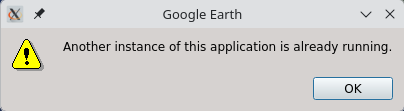
  • Google Earth – Another instance of this application is already running

    Being unable to launch Google Earth Pro because it thinks it is already running seems to be happening frequently for me. I am using the Flatpak version if it matters.

    Despite killing the application there is still a lock file lingering preventing Google Earth Pro to launch. The error message is specifically:

    Google Earth
    Another instance of this application is already running.

    To launch Google Earth again you need to delete this stale lock file which is inside your user directory:

    rm -v $HOME/.var/app/com.google.EarthPro/.googleearth/instance-running-lock

    Once gone Google Earth Pro will run again without complaining.

  • Firefox not opening mailto links in Flatpak Thunderbird

    Using Fedora Kinoite Thunderbird comes in a Flatpak. This caused me issues with mailto links in Firefox not opening Thunderbird’s new email window.

    Usually just setting Thunderbird as the default email client inside Thunderbird’s settings or KDE’s default applications would have worked. Even selecting Thunderbird inside the Firefox file handler applications settings would have done the job. However mailto links did nothing but open up the application selector in Firefox which did not work.

    The first two places were already set correctly (in Thunderbird and KDE) so not much more to do there. As I cannot directly select Thunderbird’s binary since it is a Flatpak, I tried to get Firefox to open the Flatpak binary instead and somehow customise the command being run.

    There was just no way to customise the command through its interface, unless I fiddled with handlers.json directly in my Firefox profile directory. I tried a few combinations and no dice. I was also still reluctant to believe that all other users would go through this mess just to get mailto links working which is such a basic feature.

    The most annoying part was that XDG actually returned Thunderbird as the default handler for mailto links:

    $ xdg-mime query default x-scheme-handler/mailto
    org.mozilla.Thunderbird.desktop

    But checking my ~/.config/mimeapps.list file revealed that there was no mailto handler defined. Adding the corresponding entries finally fixed the issue:

    [Added Associations]
    x-scheme-handler/mailto=org.mozilla.Thunderbird.desktop;

    [Default Applications]
    x-scheme-handler/mailto=org.mozilla.Thunderbird.desktop;

    Glad that I got it working but still not satisfied that this was really the way to go, so I decided to start from scratch.

    I went back to KDE’s System Settings>Apps & Windows>Default Applications>Email client. Despite having Thunderbird already selected I went and selected Other… instead. Here I could select Thunderbird again but interestingly there were more options:

    You will notice in my screen-shot the check-box stating “Remember application association for all files of type “x-scheme-handler/mailto“. This check-box once checked actually updates the same ~/.config/mimeapps.list file with the previous entries I mentioned earlier.

    So apparently this is an option which is not enabled by default when just selecting Thunderbird in the default applications list. Why not having mailto links working by default in KDE is a conundrum.

    I am sure there are edge cases not wanting mailto links to open the default email client, but I would assume the vast majority of users expect this behaviour of the default email client. What is the point otherwise of selecting a default application?

  • ip2.cc an alternative to hostip.info

    I have used the API of hostip.info for long time to resolve IP addresses to country codes or country names. The web service has been hit by some severe downtime lately returning “500 – Internal Server Error” for any calls including both API and website page requests. As of now hostip.info has been down and unreachable for several days in a row, with no signs of coming up in the near future. Perhaps the maintainer is on holiday or something…

    I manage several applications depending on this web service so I started searching for an alternative solution to lookup IP addresses. I did not find anything suitable so I decided to launch my own free IP to country lookup API instead.

    This new web service can be found at ip2.cc (IP to Country Code) for everyone to use.